

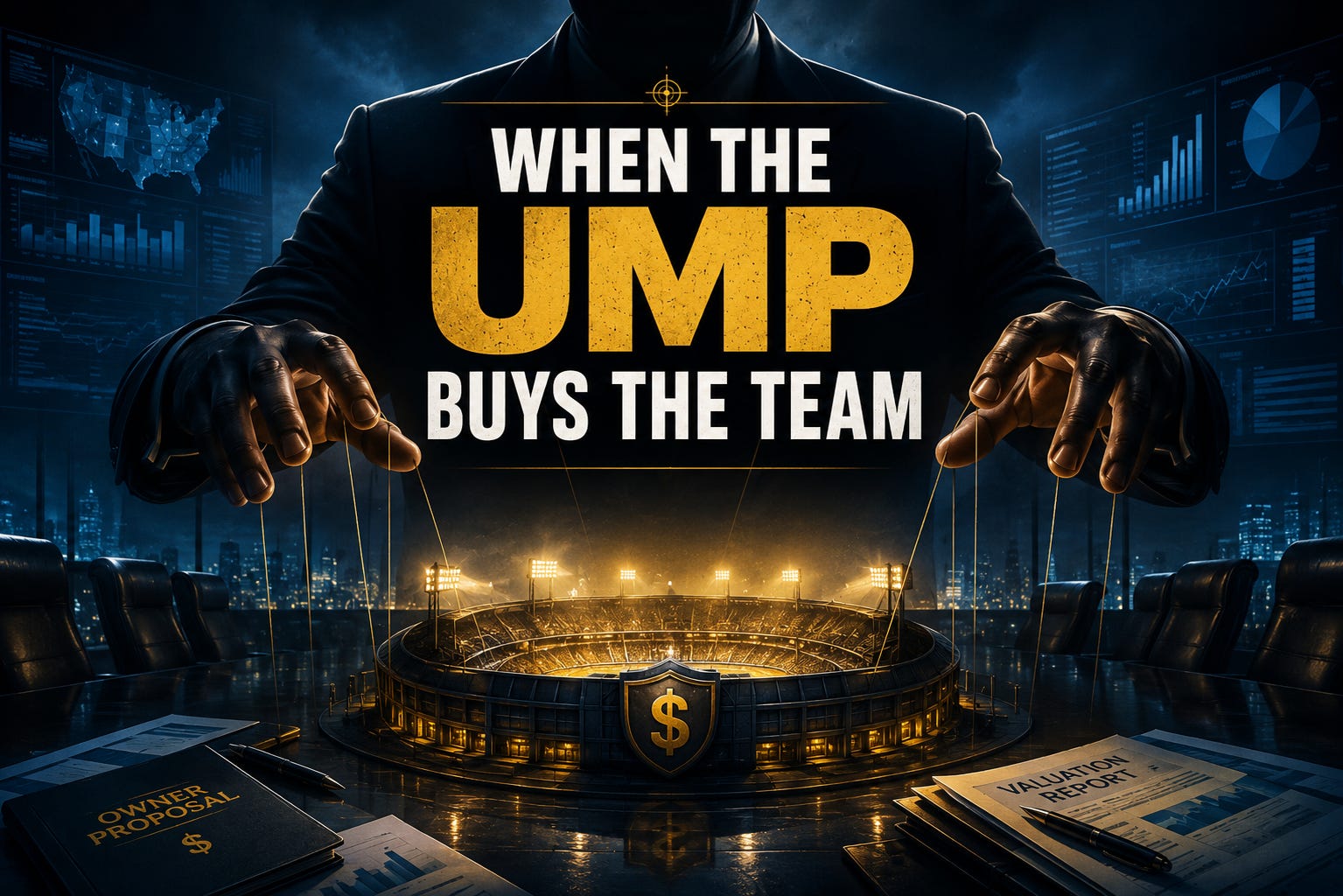
You know things have gone off the rails when the White House starts talking about buying shares in the same AI companies it’s supposed to keep in check.
In the span of a few news cycles, we went from “the government will regulate AI” to “the government might take equity stakes, pre‑approve the models, and then deploy them across federal agencies” - all while investors cheer and the *IPO bankers start picking out yacht names.
If you pitched this as a script: regulator, shareholder, and power user all rolled into one, you’d get told to dial it back. Reality has no such notes.
The referee who wants a jersey
Here’s the basic play the last couple of weeks have sketched out.
Senior officials are suddenly very excited about the idea of the U.S. government owning pieces of the major AI labs. Not just buying cloud credits and signing contracts: taking equity stakes in the companies themselves, with profits funneled into some future national wealth vehicle that can send voters a thank‑you dividend every so often.
At the same time, the White House is pushing a “voluntary” pre‑release model review system. Before a lab can unleash its most powerful models, it’s supposed to bring them to Washington for a friendly checkup in the name of “security” and “safety.”
Layer on top of that the push to wire these same systems into critical infrastructure: law enforcement, border control, intelligence, defense, and the broader bureaucracy.
So in one tight little bundle you have:
The rule‑writer.
The early‑access customer.
And a prospective shareholder.
You don’t have to be a legal scholar to see the problem there.
When the referee starts asking for a cut of the betting pool and the playbook, you’re not watching a fair game anymore. You’re watching a merger.
The *IPO window doesn’t stay open forever
None of this timing is mysterious. The AI giants can read a clock.
The market has already priced these firms like they’re guaranteed to be the next trillion‑dollar platforms. That kind of faith has a half‑life. If you’re in the C‑suite, your job right now is simple: get to IPO or a liquidity event before everyone notices the numbers don’t remotely justify the mythology.
So of course, headlines about the U.S. “considering equity stakes in AI firms” light up tech stocks. The message investors hear is, “Don’t worry, kids, dad’s coming to the casino.”
OpenAI and others have been workshopping the “public wealth fund” idea in Washington or months - pitching government stakes as enlightened patriotism instead of what they actually are: a bailout pre‑wire.
If your business plan quietly assumes “and then the government will have to backstop us,” you’re not a bold innovator. You’re an off‑balance‑sheet liability waiting for a crisis.
AI for people, or AI for managing people?
Let’s step back from the money for a second and look at what kinds of systems are actually being prioritized.
You hear almost endless talk about “AI to help people” and “AI assistants for everyone.” But when you look at where the real energy is, it’s not in tools that give individuals more agency. It’s in wiring AI into the control stack:
Identity‑bound access rails that start as child‑safety and fraud prevention measures and end up deciding who can see which platforms, services, or conversations.
Risk‑scoring models that begin life as cybersecurity and threat detection tools and quietly become a sorting hat for citizens: which job application, visa request, or protest gets flagged as “concerning.”
Content‑filtering and recommendation systems tuned under the banner of “responsibility,” which boil down to adjustable dials for what topics stay visible and which quietly sink.
AI is not being rolled out first as a neutral thinking aid for individuals. It’s being wired first into the systems that manage individuals. The dashboards are getting smarter long before the people being watched do.
If your new technology shows up first as a way to monitor and steer millions of people and only later as something that helps one person think better, you’ve already told us who it was really built for.
Cozy doesn’t begin to cover it
You can measure how bad the conflict of interest is getting by counting how often the same few names keep reappearing in different roles.
The executives pitching creative equity‑sharing schemes → to the administration:
are the same ones lobbying on AI rules and positioning their firms as indispensable “national security partners.”
Companies that enthusiastically applaud new executive actions also make sure investors know they’re tight with policymakers: because being “inside the tent” is now a valuation driver.
Meanwhile, AI money is flowing into politics through Super *PACs and influence operations tailored to shape the midterms: the elections that will decide who sits on the committees writing the rules for these same firms.
We’re not talking about some big, diverse ecosystem here. We’re talking about a very small dinner party where everyone seems to be trading name tags: regulator, lobbyist, contractor, donor, advisor, investor.
When the same handful of players keeps showing up as author of the rules, applicant for the license, and beneficiary of the contract, it’s not “ecosystem growth.”
It’s vertical integration with extra steps.
“Safety” as the latest growth hack
There are real safety questions with powerful AI systems. But look closely at which “safety” measures actually move fast and which ones die in committee.
Anything that expands state or platform control over citizens tends to sail right through:
Mandatory identity checks, age verification, and centralized access systems.
Broad rights for agencies to demand model access, training data, and usage logs.
Pre‑release review regimes that quietly turn into soft licensing.
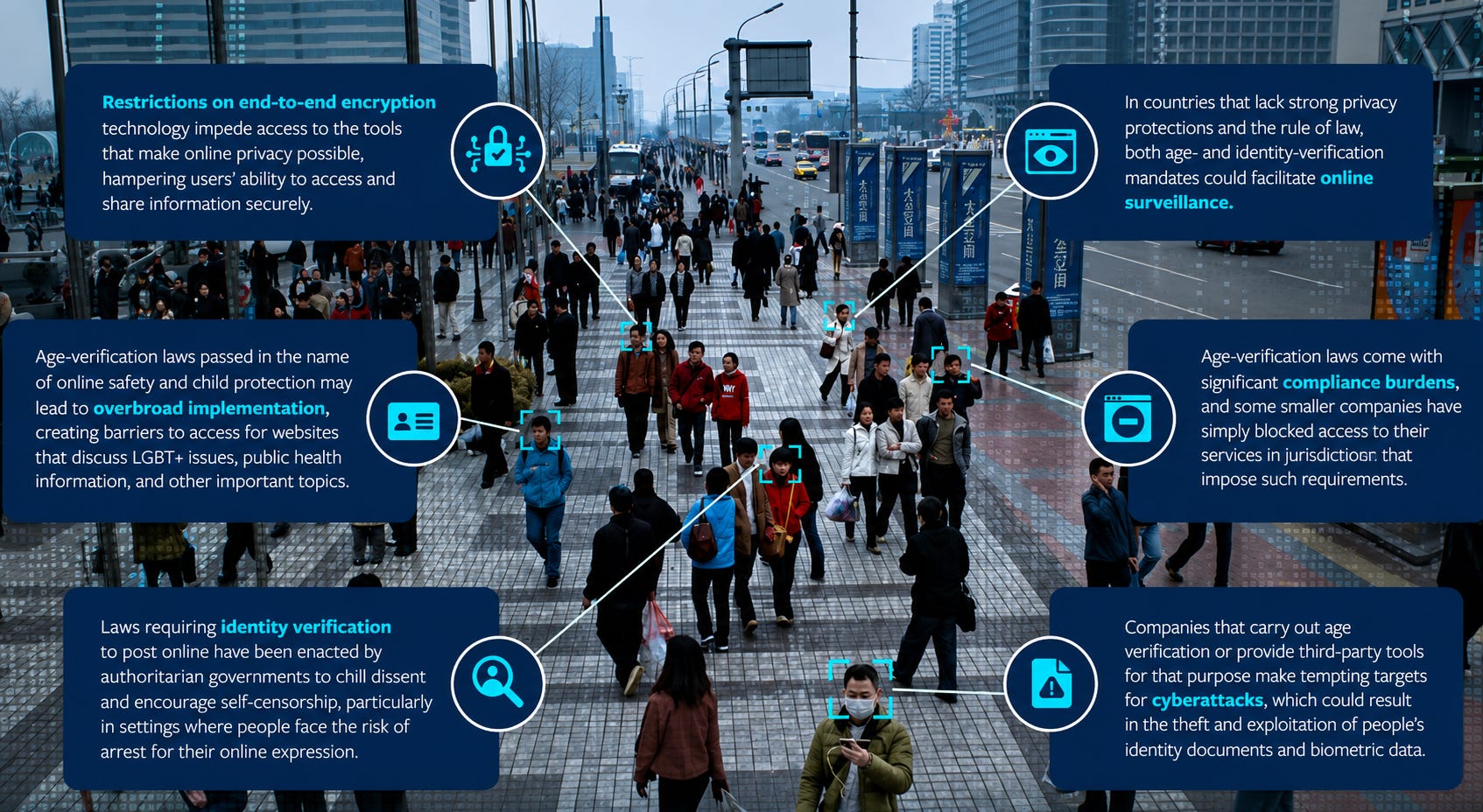
Anything that would discipline business models tends to disappear into “further study”:
Hard limits on surveillance and data hoarding.
Strict liability for harmful deployment and reckless automation.
Detailed transparency about how models are being used to score and sort humans.
“Safety” has become the fig leaf you drape over anything that makes it easier to steer populations without ever having to admit that’s what you’re doing.
We keep hearing about guardrails, but somehow they always end up bolted to the road we’re driving on, not to the cliff the car is aimed at.
The real question isn’t “are we being watched?”
The classic paranoia was simple:
are we being watched?
Cameras on every corner.
Logs of every click.
Data trails forever.
We’ve blown past that.
The live question now looks more like this:
Who controls the systems that interpret all that data?
What incentives do they face if they also own a piece of the companies selling those systems?
How easy is it for a convenient “security upgrade” to become a quiet tightening of the screws?
Once AI is treated as the back‑end infrastructure for running a country, plugging the state directly into the cap table of the firms that build it isn’t some technocratic tweak. It’s the whole ballgame.
The moment the rule‑writer starts collecting dividends on the tools that score everyone else, you’ve stopped arguing about whether you’re being watched and started living inside someone else’s optimization problem.
Even if the deal never closes, the message already did
Maybe these equity‑stake schemes never make it out of the trial balloon phase. Maybe the lawyers balk, the markets sour, and everyone shrugs and pretends this was just brainstorming.
Even then, the last couple of weeks have told us something important:
Leaders instinctively reach not for AI that expands individual autonomy, but for AI that tightens institutional control.
Conflicts of interest that would have been unthinkable a decade ago, regulator as investor as customer, are now floated with a straight face as bold policy innovation.
The default trajectory is AI as population infrastructure: a tunable layer under everyday life that decides what’s allowed, what’s risky, and what gets quietly throttled.
You don’t have to wait for the worst‑case scenario to call this what it is. The fact that:
“the government buying a piece of the AI companies it’s supposed to oversee, while wiring their systems into state power”
… can be presented as a serious option is already the warning flare.
The window is closing on whether AI becomes something that genuinely helps people, or something that helps powerful institutions manage people more efficiently. The last couple of weeks should make it very clear which way the current is flowing…
Jason Hubbard is the founder and CEO of Sacred Loop AI and an independent AI architect and researcher. He builds systems at the edge of what current AI can do and documents the gap between what the industry claims it built and what it actually built.
His work examines AI infrastructure, system design, model performance, and the technical decisions hiding beneath the industry’s marketing.
He doesn’t write to flatter engineers or comfort investors. The receipts are public. He bothers to add them up.
If this hit a nerve, share it with someone still confusing AI marketing with technical reality.
Read Jason on Medium | Follow Jason on X | Connect on LinkedIn
Glossary:
IPO = Initial Public Offering
PAC = Political Action Committee

