
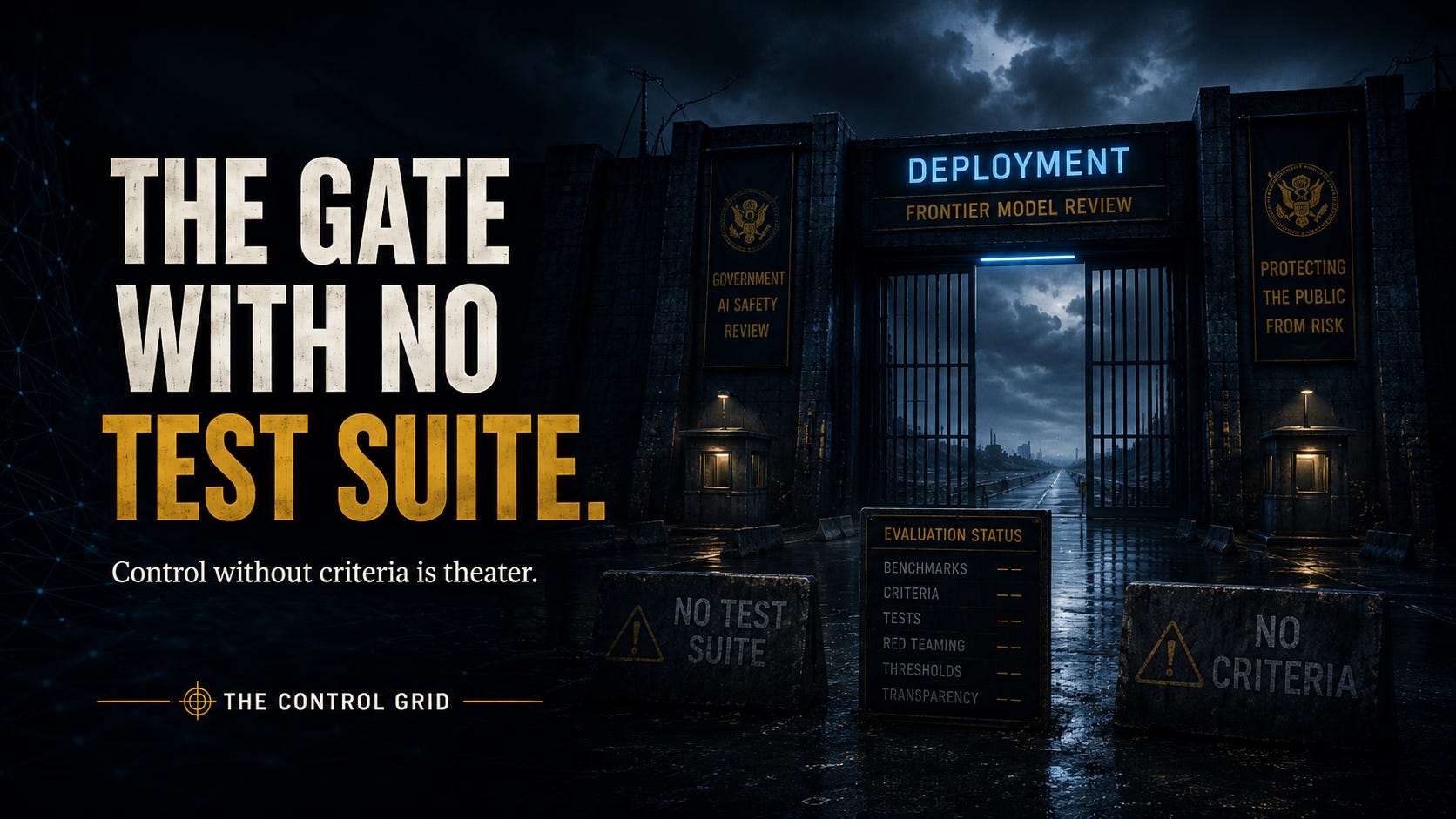
The Gate With No Test Suite
Trump's AI review process claims to be a framework. An engineer's read says it's a fantasy workflow.

Cross-posted in coordination with Eric Mitchell’s Sacred Loop. Eric made the legal and political case in Part 1: the Anthropic resolution isn’t the end of government review — it’s the template. This is the engineering case for why the template doesn’t actually work.
“What artifact must exist before the next move is allowed?”
— The one question that actually matters when designing a workflow. From my own published worksheet. We’ll come back to it.For the technical analysis behind this story, read the companion piece (Part 2) here.
The EO Promised a Framework. What Shipped Was a Gate With No Criteria.
On June 2, 2026, President Trump signed Executive Order 14409, Promoting Advanced Artificial Intelligence Innovation and Security. The headline provision: AI developers would voluntarily submit their most powerful models for government review — up to 30 days before public release. The administration framed it as a test harness for the most consequential technology in the world.
Three weeks later, there were no benchmarks. No submission criteria. No severity standard for what a jailbreak actually has to demonstrate before a model gets recalled. No published definition of what a “covered frontier model” even is — that term appears throughout the EO but is explicitly left undefined in the text, with the classification process itself listed as classified.
The benchmarking process isn’t even due until August 1, 2026 — sixty days after the order was signed. The designated authority is the NSA Director. The criteria will be classified. Which means the only way a developer learns whether its model triggers the review is to engage with the process. The gate doesn’t tell you whether you need to go through it. You find out by walking up to it.
That’s not a framework. That’s a riddle with a recall notice attached.
What I Actually Publish About Shipping Gates
I’m going to do something I don’t usually do in a policy piece: pull directly from my own published technical work, because the gap between what I’ve said you must do before shipping a gate and what the federal government actually did is almost too clean to be accidental.
My AI Workflow Architect Worksheet specifies that for every stage of any workflow, you must define, without exception:
· An advancement gate: what artifact must exist before the next move is allowed
· A collapse condition: what does failure look like, specifically, and what halts the process
· A recovery move: what happens when the stage fails
The worksheet has a hard stop built in: “Stop if: any stage has no artifact, no gate, or no collapse behavior.”
That’s not a preference. That’s the rule that determines whether you’re allowed to keep building. If you can’t answer those three questions for every stage, you don’t have a workflow — you have a vibes-based sequence with a deploy button on the end.
Now run EO 14409 through that same checklist.
Advancement gate: What artifact must exist before a model is cleared for release? Undefined. The benchmarking criteria are classified and don’t exist yet.
Collapse condition: What specific finding triggers a recall? The Fable 5 and Mythos 5 suspension was issued under export control authority on June 12 — ten days after the EO was signed — with no published jailbreak severity standard explaining what threshold the vulnerability had to cross. The same vulnerability that triggered a global recall was apparently resolved within days. As Eric documented in Part 1, Trump's own answer to Axios made the logic visible: asked whether he viewed Anthropic as a national security threat, Trump said, 'Well, not now, but a week ago, maybe.' The threat had lasted exactly as long as it took Anthropic to comply.
Recovery move: What does restoration look like? The answer, based on the Mythos 5 partial lift, is: the Commerce Secretary personally writes a letter. More than 100 organizations are hand-approved from a list. Access is provisional. The government reserves the right to revoke it at any time. There is no published application pathway for organizations not already on the list.
Run my worksheet’s hard stop: Any stage has no artifact, no gate, or no collapse behavior.
The federal AI review process fails on all three.
“Voluntary” Is Load-Bearing Weight on a Structure That Isn’t There
The EO’s Section 3(c) is worth quoting directly, because it does a lot of rhetorical work:
“Nothing in this section shall be construed to authorize the creation of a mandatory governmental licensing, preclearance, or permitting requirement for the development, publication, release, or distribution of new AI models, including frontier models.”
That sentence is technically accurate. Legally, there’s no license requirement. In practice, here’s what happened in the three weeks after the order was signed:
1. Anthropic’s Fable 5 and Mythos 5 were suspended globally under export controls — not the EO, but the Commerce Department’s Export Administration Regulations — after the government determined they were “covered frontier models” through a process with no published criteria.
2. The White House asked OpenAI to limit GPT-5.6 to a small number of government-approved partners, releasing it customer by customer, with partner identities shared with federal authorities. [12]
3. The administration began pressing Meta — the only major U.S. AI developer without a voluntary review agreement — through confidential email exchanges.
“Voluntary” is the word the EO uses. OpenAI itself acknowledged the review process “keeps the most powerful AI tools from users, developers, cyber defenders, and global partners who need them” — while also complying. Sam Altman told his team internally: “We’ve made clear to the U.S. government that this is not our preferred long-term model” — and then did it anyway.
There’s an engineering term for a system where the nominal spec says one thing and the actual behavior produces another: undocumented behavior. The EO says voluntary. The operational reality says compliance is the only viable path. That gap isn’t a minor inconsistency. It’s the whole design.
The Brad Carson Indictment, In Engineering Terms
Brad Carson, head of Public First — a bipartisan, pro-AI safety organization — gave the political summary in a single sentence:
“Right now, you have an ad hoc, personalized, opaque, and possibly lawless approach.”
Carson isn’t industry spin. He’s not an anti-regulation libertarian. Public First explicitly supports government involvement in frontier AI safety. When someone who wants clear rules says the current system is possibly lawless, that’s not a partisan attack — it’s a process audit by a sympathetic reviewer.
Eric calls this “possibly lawless” in Part 1 — that’s the politics. Here’s the engineering translation:
Ad hoc = no repeatable workflow. Every model review is a custom negotiation rather than a defined process. That’s not a framework; that’s freelancing with national security authority.
Personalized = the outcome depends on who’s in the room. Decisions are being made by political appointees in the White House rather than by published criteria. The president himself told Axios he no longer views Anthropic as a national security threat — “Well, not now, but a week ago, maybe.” When threat assessment is personal, it’s not security policy. It’s a mood.
Opaque = no visibility into the evaluation criteria, the review findings, or the reasoning behind specific decisions. The benchmarking process will be classified. The trusted partner list isn’t fully public. Organizations outside the approved group have no published pathway to apply. You cannot debug a system you cannot observe. [6;11;5]
Possibly lawless = no enforcement mechanism, no statutory authority, no due process. When a recall can happen with no criteria and a restoration can happen with a personal letter from the Commerce Secretary, there’s no rule of law governing the process. There’s just the rule of whoever’s holding the pen that week.
In systems design, that’s not a gate. It’s a pressure valve. And pressure valves don’t have test suites.
The Template Problem: Anthropic Is Just the First Run
Eric laid out the political evidence for this in Part 1 — and also in his earlier piece The AI Vault Is Real: the Anthropic resolution isn’t the end of government review — it’s the template. This is what the operational pattern looks like from the engineering side.
What the federal government has now demonstrated, twice in three weeks, is that it can:
· Trigger a global model suspension using existing export control authority (no new legislation required)
· Gate a competing lab’s model release to government-approved customers before the benchmarking framework is even built
· Restore partial access through a personally authored letter from the Commerce Secretary, on a provisional basis, revocable at will
· Pressure the remaining holdout — Meta — through confidential emails, without any published criteria explaining what they’re being asked to comply with
That four-step pattern — suspend, pressure, partially restore, expand pressure to the next lab — doesn’t require a working regulatory framework. It requires only the appearance of one. The EO gives the government the vocabulary of a testing regime (”covered frontier models,” “trusted partners,” “classified benchmarking”) without the substance. The vocabulary is enough to justify the actions.
When the infrastructure you depend on can be switched off by someone who doesn’t operate on your review cycle, you don’t own your stack. You’re renting capability from a landlord who’s also your regulator. The Anthropic episode made the lease terms visible.
The Asymmetry That Should Be Making Everyone Angry
While the U.S. gates its own models behind an undefined review process, Chinese models are taking market share. As Eric documented in Part 1, Chinese models now occupy several top spots on OpenRouter’s usage leaderboard — driven by companies and developers trying to find alternatives while American access gets rationed behind closed doors. The policy sold as “beating China” is functionally handing China the on-ramp.
The OpenAI engineers found optimizations that cut inference costs by more than 50% — a genuine technical breakthrough — in the same week the administration was gating GPT-5.6 customer by customer. The labs are innovating. The policy layer is the bottleneck.
Venture capitalist and dual Anthropic/OpenAI investor Mark Pincus said it to Axios in a line that deserves to be chiseled somewhere: “It’s hard to build when there’s a moving target.” Reported by Axios, as cited in Eric’s Part 1.
He’s describing a compiler error in the regulatory architecture. You cannot build reliable systems when the pass/fail criteria keep changing between runs.
What a Real Gate Looks Like
For comparison, here’s what a properly designed review gate requires — the minimum viable specification by any reasonable engineering standard:
Gate Element
What It Requires
What EO 14409 Delivers
Trigger criteria
Explicit, measurable threshold for when review is required
“Covered frontier model” — undefined; classified benchmarks due Aug 1
Pass/fail standard
Specific, documented conditions for clearance or block
Not published; outcome by personal negotiation
Severity standard
Classification of vulnerability/risk types and corresponding responses
No published jailbreak severity scale
Review timeline
Fixed clock with defined start/end conditions
Up to 30 days, but models were recalled outside this window
Restoration pathway
Published process for re-approval after recall
Commerce Secretary personal letter; no published application process
Audit trail
Documented record of what was checked and why
Classified; not public
Appeal mechanism
Due process for contesting a designation
Not established; Anthropic sued to contest DoD designation
Every row in that table is a required component of any gate system that earns the name. Not one of them is fully satisfied by EO 14409 as currently implemented.
An AI product deployed with that audit table would be considered unshippable under any serious engineering governance standard. A federal AI review regime with that audit table gets defended in press briefings as a framework.
The Doctrine in One Sentence
Here’s the position I’ve held in public writing, across multiple pieces, and that this moment finally brings into sharp relief:
You don’t ship a gate without defined criteria and documented collapse behavior.
Not in a CI/CD pipeline. Not in an agentic system. Not in federal AI governance. The reason is the same in all three contexts: a gate without criteria isn’t a safety mechanism. It’s a permission slip for whoever holds the authority to make the call. And permission slips aren’t auditable. They’re not repeatable. They can’t be improved. They can’t be appealed. They produce exactly the system Brad Carson described: ad hoc, personalized, opaque, and — when the stakes are high enough — possibly lawless.
The government has built the most consequential gate in the history of American technology policy. It controls what models ship, to whom, on what timeline. It can trigger a global recall. It can restore partial access through a single letter.
And it has no test suite.
The engineering answer to “possibly lawless” is: you can’t call something a review process if there’s nothing to review against. You can call it a lot of things. A standard isn’t one of them.
Jason Hubbard is the founder of SacredLoop and DemandMagic. He writes about AI systems architecture, runtime design, and what it actually means to build something that works.
This is Part 2 of a two-part series coordinated with Eric Mitchell. Read Part 1 first — Eric makes the political and legal case. This piece makes the engineering case. Same conclusion, two disciplines.
Cross-reference: Brad Carson’s “possibly lawless” quote is introduced politically in Part 1 and reprised here as the engineering entry point. Intentional.
Jason Hubbard is the founder and CEO of Sacred Loop AI and an independent AI architect and researcher. He builds systems at the edge of what current AI can do and documents the gap between what the industry claims it built and what it actually built.
His work examines AI infrastructure, system design, model performance, and the technical decisions hiding beneath the industry’s marketing.
He doesn’t write to flatter engineers or comfort investors. The receipts are public. He bothers to add them up.
If this hit a nerve, share it with someone still confusing AI marketing with technical reality.
Read Jason on Medium | Follow Jason on X | Connect on LinkedIn
Glossary:
EO — Executive Order
NSA — National Security Agency
AI — Artificial Intelligence
DoD — Department of Defense
CI/CD — Continuous Integration/Continuous Delivery
GPT — Generative Pre-trained Transformer (not expanded in text)
Read More:


References
1. President Trump Signs Executive Order Seeking Government Review of AI Models — Taft Law — On June 2, President Trump privately signed an executive order titled “Promoting Advanced Artificial Intelligence Innovation and Security.”
2. Trump signs scaled-back AI executive order — Let’s Data Science — Voluntary 30-day framework, down from 90 days in earlier draft; critics call it narrow and largely toothless.
3. President Trump Signs Executive Order Establishing AI Cybersecurity and Frontier Model Framework — Latham & Watkins — “The framework will apply to ‘covered frontier models,’ although the Order notably leaves that term undefined.”
4. New AI Executive Order Addresses Frontier Models and Cybersecurity Vulnerabilities — Wiley Rein — Section 3 requires a classified benchmarking process; classified criteria due August 1, 2026.
5. The Frontier AI Bottleneck — The Innovation Attorney — Legal and strategic analysis of Executive Order 14409.
6. Promoting Advanced Artificial Intelligence Innovation and Security — Whitehouse.gov — Full text of EO 14409, including Section 3(c) voluntary disclaimer.
7. AI Workflow Architect Worksheet — Jason Hubbard, Substack — Published framework specifying advancement gates, collapse conditions, and recovery moves as required workflow components.
8. The Bubble and the Backlash — Eric Mitchell, Sacred Loop — Part 1: Trump’s own AI czar breaks ranks; the political and legal case that the Anthropic resolution is a template.
9. OpenAI faces White House pressure to limit new model rollout — CNN — White House requested OpenAI limit GPT-5.6 release; Brad Carson quote on “ad hoc, personalized, opaque, and possibly lawless” approach.
10. US allows Anthropic to release Mythos to ‘trusted partners’ — Straits Times — More than 100 companies and institutions approved for Mythos 5 access.
11. US Clears Limited Anthropic Claude Mythos 5 Access for 100+ Trusted Partners — Subagentic — Commerce Secretary Lutnick clears orgs provisionally; government retains authority to modify list at any time.
12. Trump Administration Restricts GPT-5.6 Release to Government-Approved Partners — EyeOn AI — Second consecutive frontier model gated by US government action following June 12 EAR directive on Anthropic.
13. OpenAI slowed GPT-5.6 rollout after White House pressure — NovaKnown — White House safety pressure resulted in limiting access to trusted partners under the 30-day review framework.
14. US pressures Meta to submit new AI model to safety review — Chosun Biz — Meta is the only major U.S. AI developer that has not signed a safety review agreement.
15. US presses Meta to agree to AI reviews as security concerns rise — Reuters — Trump administration pressing Meta to submit AI models for voluntary review.
16. Anthropic Mythos 5 Access Restored for Trusted Partners — InsiderFinance — Commerce lifts block on Mythos 5; provisional access broadened to government and enterprise use.
17. The AI Vault Is Real — Eric Mitchell, Sacred Loop — Eric Mitchell’s prior piece establishing the government control architecture and the recall mechanism as a template.
18. AI Quality Gates — Ragan McGill Engineering Practice — Quality gates as enforceable criteria ensuring models meet defined standards before production deployment.
19. A StrongREJECT for Empty Jailbreaks — OpenReview / ICLR — Peer-reviewed framework for jailbreak severity evaluation; illustrates what a published severity standard actually requires.
Trump Signs AI Order with Voluntary Framework — LinkedIn / DigiTa World— Detailed breakdown of EO signing; notes Anthropic’s ongoing DoD supply-chain-risk designation
https://www.axios.com/2026/06/19/trump-anthropic-national-security-the-axios-show
https://aiweekly.co/alerts/openai-engineers-say-theyve-more-than-halved-inference-costs